2011/12/07

"A date which will live in infamy".

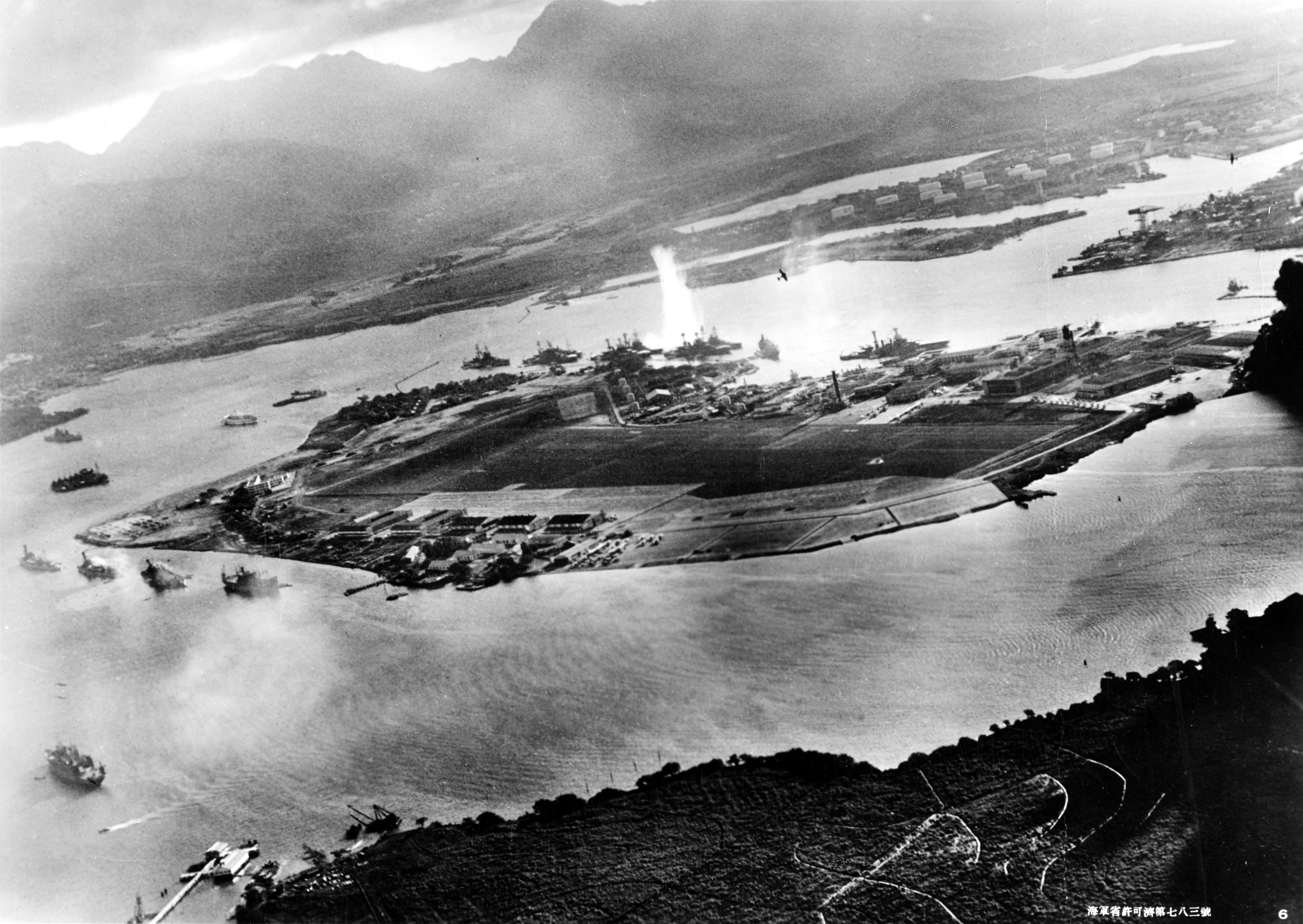
The attack on Pearl Harbor (called Hawaii Operation or Operation AI[6][7] by the Japanese Imperial General Headquarters (Operation Z in planning)[8] and the Battle of Pearl Harbor[9]) was a surprise military strike conducted by theImperial Japanese Navy against the United States naval base at Pearl Harbor, Hawaii, on the morning of December 7, 1941 (December 8 in Japan). The attack was intended as a preventive action in order to keep the U.S. Pacific Fleet from interfering with military actions the Empire of Japan was planning in Southeast Asia against overseas territories of the United Kingdom, the Netherlands, and the United States.
The base was attacked by 353[10] Japanese fighters, bombers and torpedo planes in two waves, launched from six aircraft carriers.[10] All eight U.S. Navy battleships were damaged, with four being sunk. All but two of the eight were raised, repaired and returned to service later in the war. The Japanese also sank or damaged three cruisers, three destroyers, an anti-aircraft training ship,[nb 2] and one minelayer. One hundred eighty-eight U.S. aircraft were destroyed; 2,402 Americans were killed[12] and 1,282 wounded. The power station, shipyard, maintenance, and fuel and torpedo storage facilities, as well as the submarine piers and headquarters building (also home of the intelligence section) were not attacked. Japanese losses were light: 29 aircraft and five midget submarines lost, and 65 servicemen killed or wounded. One Japanese sailor was captured.
The attack came as a profound shock to the American people and led directly to the American entry into World War II in both the Pacific and European theaters. The following day (December 8) the United States declared war on Japan. Domestic support for isolationism, which had been strong, disappeared. Clandestine support of Britain (for example the Neutrality Patrol) was replaced by active alliance. Subsequent operations by the U.S. prompted Germany and Italy todeclare war on the U.S. on December 11, which was reciprocated by the U.S. the same day.
There were numerous historical precedents for unannounced military action by Japan. However, the lack of any formal warning, particularly while negotiations were still apparently ongoing, led President Franklin D. Roosevelt to proclaim December 7, 1941, "a date which will live in infamy".


2011/11/10

Veteran's Day 2011

“TO HONOR VETERANS OF ALL WARS”
Raymond Weeks of Birmingham, Alabama, organized a Veterans Day parade for that city on November 11, 1947, to honor all of America's Veterans for their loyal service. Later, U.S. Representative Edward H. Rees of Kansas proposed legislation changing the name of Armistice Day to Veterans Day to honor all who have served in America’s Armed Forces.


In 1954, President Dwight D. Eisenhower signed a bill proclaiming November 11th as Veterans Day and called upon Americans everywhere to rededicate themselves to the cause of peace. He issued a Presidential Order directing the head of the Veterans Administration, now the Department of Veterans Affairs, to form a Veterans Day National Committee to organize and oversee the national observance of Veterans Day. In addition to fulfilling that mission, the committee oversees the annual production and distribution of the annual Veterans Day poster and this Teacher Resource
Guide.


In 1968, Congress moved Veterans Day to the fourth Monday in October. However, it became apparent that the November 11th date was historically significant to a great many Americans. As a result, Congress formally returned the observance of Veterans Day to its traditional date in 1978.


The Veterans Day National Ceremony is held each year on November 11th at Arlington National Cemetery. At 11 a.m., a color guard, made up of members from each of the military services, renders honors to America's war dead during a tradition-rich ceremony at the Tomb of the Unknowns. The President or his representative places a wreath at the Tomb and a bugler sounds “Taps.” The balance of the ceremony, including a "Parade of Flags" by numerous Veterans service